How the TV size calculator works
The right TV size depends on how much of your view the screen fills, measured as a viewing angle. Two standards are widely used:
- SMPTE (30°): the Society of Motion Picture and Television Engineers suggests the screen fill about 30 degrees of your view. That's comfortable for everyday TV, news and sports.
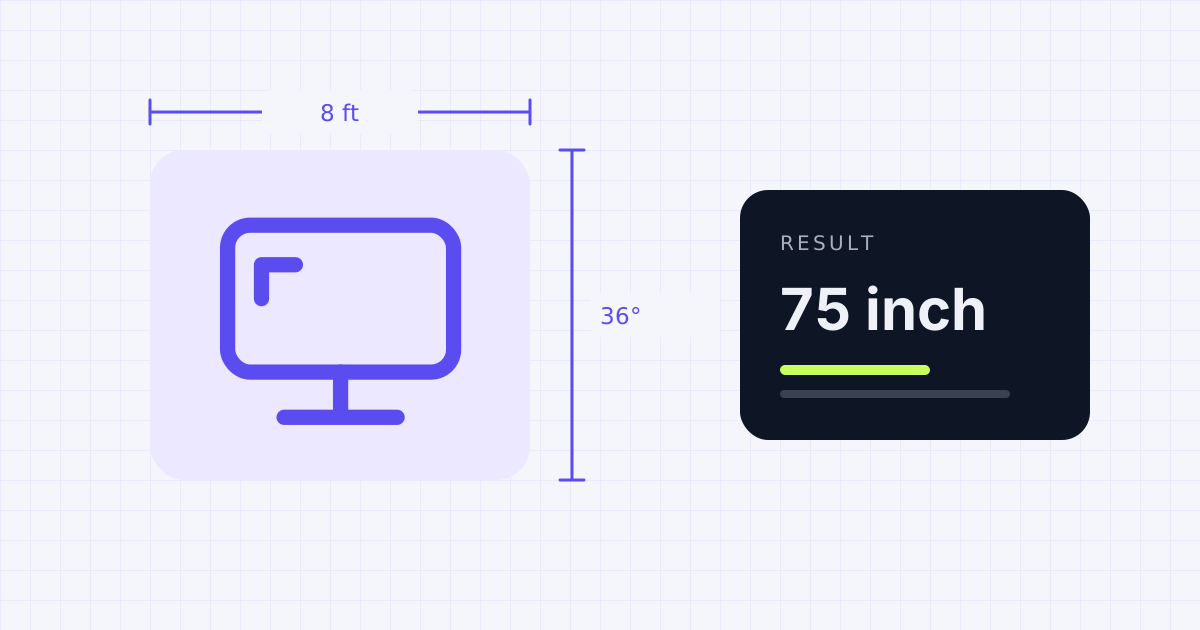
- THX (36°): recommends about 36 degrees for the best seat in a cinema-style setup, mainly for movies. Some home theater fans push this to 40.
The calculator turns your seating distance and chosen angle into a screen width, converts that into a diagonal size for a standard 16:9 TV, and then picks the nearest common size you can buy.
Example: a sofa 8 feet from the TV
- 8 ft = 96 inches to the screen
- At 30°, the ideal width is about 51 in, or a 59-inch diagonal
- Nearest common size: 55 inch
- At 36°, the ideal diagonal is about 72 inches, so a 75-inch TV
Why resolution matters
With a 1080p TV, sitting too close lets you see the individual pixels. 4K packs four times as many pixels into the same screen, so you can sit much closer, or go bigger, and the picture stays sharp. The calculator shows the closest distance before an average viewer would start to notice pixels.
Before you buy
- Measure the wall or stand space too. A TV's width is roughly 87 percent of its diagonal size.
- For a mounted TV, the center of the screen should sit close to eye level when you're seated.
- If you're torn between two sizes, most people end up wishing they'd gone bigger.
Once it's set up, check the panel with our dead pixel test while you're still inside the return window.
Frequently asked questions
What size TV should I get for 10 feet?
At 10 feet, a 30-degree viewing angle suggests about a 74-inch screen, so a 75-inch TV. For a cinema feel at 36 degrees, you'd go up to about 85 inches.
How far should I sit from a 65 inch TV?
For mixed viewing, about 8.5 to 9 feet. For a more immersive movie setup, about 7 to 7.5 feet works well on a 4K TV.
Is 4K worth it for a small TV?
On smaller TVs viewed from across a room, the difference is harder to see. 4K matters most on big screens and when you sit close.
Does the calculator work for projectors?
Yes. Use the result as the screen diagonal. Projector screens are often sold in 16:9 sizes, just like TVs.
Sources
- Home Theater US: Screen size vs viewing distance, THX and SMPTE guidelines
- RTINGS: TV size to distance calculator and the science behind it
Results are a guide based on common viewing-angle standards. Personal taste, room layout and content matter too.
Spotted a mistake? Email [email protected] and we'll check it.